
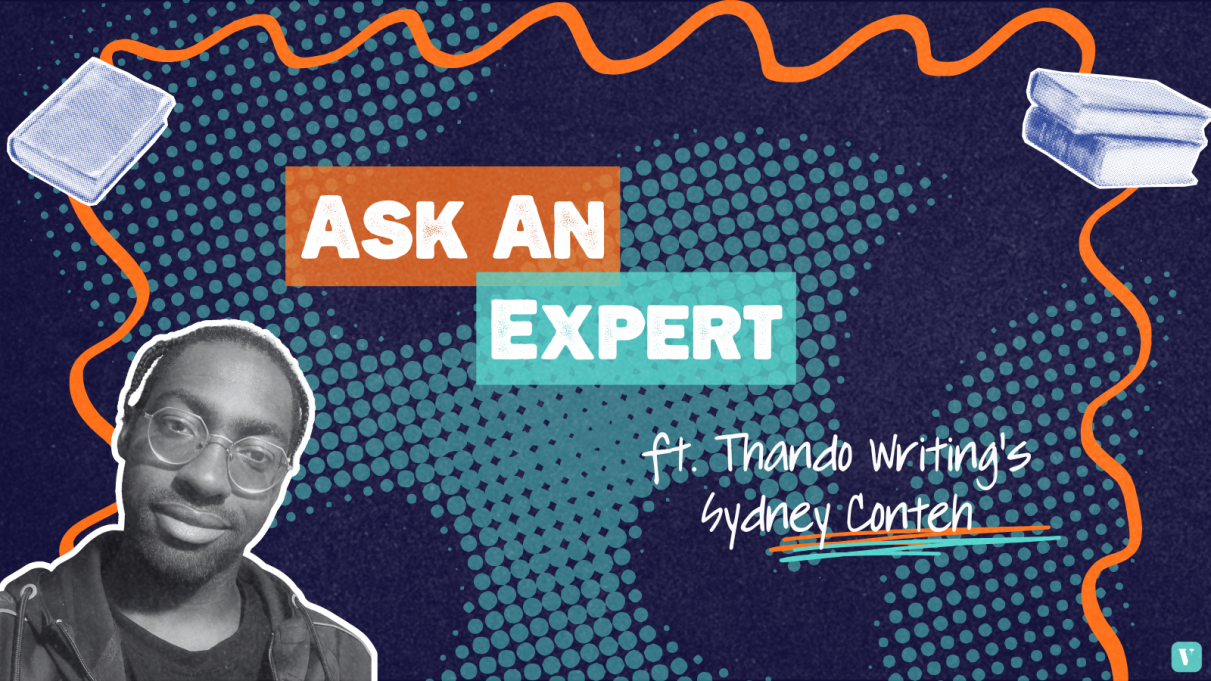
Founded by Sydney Conteh, Thando Writing is an organisation that lives and breathes advocacy for writing and the benefits it has on mental health. Sydney's enthusiasm for writing is clear to see throughout the organisation’s global in-person and online workshops.
Thando Writing works with young people, schools and audiences on all types of literature and from any background! From short stories, poetry, novels and more, you can join Thando Writing from any level and step of your journey.
Interview conducted by VoiceBox's Lauren Louisha

Hi Sydney! Thanks so much for joining us. We really admire the incredible work you’re doing with young people at Thando Writing. Could you start by telling our readers a bit more about the mission and work of Thando Writing?
Thando Writing is a platform that makes writing accessible. We have many branches, including the literature side, where we write articles about writing poetry and creative exercises to do at home. We also have the advocacy side, where we work with companies and with councils to make writing more accessible and approachable. And then there's the media side, where we interview writers and authors.
The idea initially began five years ago, when I had already published some poetry and had done some freelance work under the pen name Thando Writing. So I developed Thando Writing into a platform, and then eventually I turned it into a company so we could help people on a larger scale.
I am very fortunate to have a business partner; he is grounded, and I'm the dreamer, so it works well. We’re always striving to do better and keep growing.
How do you hope Thando Writing helps young people grow as writers and as individuals?
We would love to inspire people to write books and get into the publishing world. Get them to that moment where they've written a lot, and they're like, “I have a voice, and I want to publish it”. Making writing accessible to all is our motto; that is what we advocate for.
Writing is a passion that can follow you for your whole life, and if we can teach young people to get into the habit of writing things out, they’ll always have a place to express themselves and help heal themselves on paper.
That, for me, is what Thando Writing is all about. Whether you want to become a professional writer or you just want to do it as a hobby, we advocate for the love of writing, whether it be poetry, novels, or short stories. We even dabble in music writing because when you look at lyrics, you’re looking at music poetry. It's getting young people to love writing and using it as a way to help themselves.
Of course, the young people you work with are learning from you, but has there been a moment where you felt you were the one learning from them?
All the time!
So, within the realms of Thando writing, there's this one young person I worked with whose style is poetic and very meta; he uses a lot of metaphors. At the time, I kind of lost my voice a little bit as a poet. So I kept asking myself, “What am I writing for? What am I doing? What is my intention and reason for writing?”
As he was writing, he just reminded me why I write. The way he was expressing himself, the way he was talking about his family, his culture, his identity. It just made me go, “Okay, and I lost my meaning, and you showed me my meaning.”
So, that's one of the big ones. And I feel like every writer will go through that moment where you lose your voice a little bit, you need someone, and find motivation through young people. They are kind of like a mirror to your past.
How have you seen creative expression playing a role in young people’s mental well-being?
Just being able to talk about things, being able to unburden themselves. I think nowadays being a young person is the hardest it's ever been. Being a near-peer and in that middle age gap, I understand what it's like to be young. I’m also connected enough to the older generation to help in other ways.
The parents of young people don't always understand what it's like to be them. Sometimes they look back on their younger years, and they’re like, ‘Things were easy. ’ But pressures are different today.
Young people are carrying and struggling with all this stuff, with nowhere to put it, but writing helps them map out how to deal with things.
And whether it's an hour writing session, half an hour, or even five minutes, just writing about it helps them get out of their heads and soothe their minds. Creative expression gives young people time to just unburden everything that's affecting them and have some peace.
You’ve shared that you were born during the Sierra Leonean Civil War. Has that part of your life shaped your writing?
More in the past. I feel now I kind of have a healthier relationship with it.
There are moments where I look back and think in an alternate universe, I would not be here talking to you, and I'm very aware of that. I'm very fortunate to have gone through the war as a baby and not as someone older.
That doesn't mean it doesn't affect me as much as teenagers who lived through the war; there is, of course, a difference when you go through it as a teen/adult because you have the memories. There's also the survivor's guilt that comes with having no control over something.
In any single poem or piece of literature that I write, no matter how dark it is, I think that's where being born and raised in a civil war kind of affects my writing. There's always hope because I think, okay, I survived the war. I can do anything. I have a perspective that is unique, and no matter if I'm writing the darkest poem, I always try to end on a good note because life lives on.
A poem I’ve never published or performed, called Stars, gives the idea that everywhere I walk, I'm carrying these stars and these stars are the kids that died.
There are so many kids who shouldn’t have died. They could have been doctors, scientists. could have cured cancer. So what am I doing now? Not just to live with their legacy, but to keep forwarding knowledge of how fortunate I am.
How would you describe your poetic voice and style?
I'm a mixture of contemporary, think poets like Rudy Francisco, who is an American spoken word artist. I also battle rap, which I count as poetry, and then I have the classical feel, like there's an old man in me, where my favourite poets are people like Pablo Neruda. He's one of my favourites from the 1940s, very elegant, very subtle. He was more of a storyteller than a poet.
He never rhymed, and I don't either. I don't count myself as a rhyming poet even though I have in the past. I feel like when you've written enough times, you have that in your locker. But I have to sit down and plan. Rhyming doesn't come naturally.
So I am a mixture of an old romantic style of poetry with some contemporaries like Rudy Francisco, Maya Angelou, and the rawness of rap and battle rap, all put into one.
As someone who has been through the publishing journey, what’s one piece of advice you’d give to a writer trying to get their first book out there?
There's a lot here! Can I give three? The first one is to find your voice. A lot of publishers would like to know what your style is like.
So when I write my synopsis on any book, I always explain which artists inspired me, so when the publisher is reading the synopsis, before they even open the manuscript, they can imagine the person's voice through other contemporary artists. Ask yourself who you're a mixture of. So that's the first one. Find your voice!
The second one is, find your reason why. At the end of the day, your actual book sales will likely only make up maybe 30% of your income.
What you use in your book is almost like a CV. For me, I use my books for Thando Writing. So, using your books is a key to go into different areas that you want to go into that you want to navigate. So find your reason!
And the third one, and this one's more technical. You need to find your balance. When you're making your final draft, you have to write something that's appealing to the public whilst still having your voice, identity and your message.
There's a tight rope to it, you can't go too much one way where you're appealing so much to the public that they don't even see who you are as an author and vice versa.
It’s been such a pleasure to have you join us for our Expert Interviews series. Before we wrap up, can you give us a step-by-step guide on how young people can start to work with Thando writing
Firstly, we have our workshops, which can be found on our social media, Eventbrite or our website; these are free or on a donation basis.
If you want to get involved with writing and want inspiration from writers, we have articles and interviews you can check out. Again, that's completely free.
We also have our own articles where we cover topics like AI and the effects it has on writing. If you want to improve your writing, we have exercises available, which allow us to keep in tune with our motto of making writing accessible.
We do one-on-one tutoring as well! Just contact us, tell us about your book, and we’ll take it step by step from there. We want you to have the freedom and confidence within your work to go wherever you want.
If you don’t want to write a book, but want to improve your writing, we can do one-to-one sessions for that, too! One part of Thando Writing is inspiring new authors, and the other part is helping people love writing. So, for example, if you just want to have a three-week one-to-one workshop on how to improve metaphors or writing for mental health, we can work on that too.
Support Young Creators Like This One!
VoiceBox is a platform built to help young creators thrive. We believe that sharing thoughtful, high-quality content deserves pay even if your audience isn’t 100,000 strong.
But here's the thing: while you enjoy free content, our young contributors from all over the world are fairly compensated for their work. To keep this up, we need your help.
Will you join our community of supporters?
Your donation, no matter the size, makes a real difference. It allows us to:
- Compensate young creators for their work
- Maintain a safe, ad-free environment
- Continue providing high-quality, free content, including research reports and insights into youth issues
- Highlight youth voices and unique perspectives from cultures around the world
Your generosity fuels our mission! By supporting VoiceBox, you are directly supporting young people and showing that you value what they have to say.